
Concurrency in Go: Beyond Goroutines and Channels
Concurrency in Go: Beyond Goroutines and Channels
Go makes concurrency accessible. Building concurrent systems that remain predictable and efficient under production workloads requires a deeper understanding of the runtime and synchronization model.
Introduction
Concurrency is one of Golang’s defining characteristics. Goroutines and channels provide an elegant programming model for executing multiple independent operations concurrently.
However, launching thousands of goroutines doesn’t automatically translate into a scalable application.
In production backend systems, concurrency introduces important engineering challenges:
- How do we coordinate access to shared state?
- How do we prevent race conditions?
- How do we control the number of concurrently executing operations?
- How do we propagate failures and cancellation?
- How do we prevent downstream dependencies from becoming overwhelmed?
Take an example of a payment processing service handling thousands of requests per second. Each request might involve database operations, external API calls, and transaction persistence.
Concurrency can improve throughput by allowing independent operations to overlap, but without proper synchronization and resource management, it can also introduce unpredictable behavior and system instability.
The real engineering challenge isn’t creating concurrent execution paths. It’s ensuring they remain efficient under load and do no lead to unpredictable behavior.
1. Concurrency vs. Parallelism
A fundamental question which engineers struggle to understand the difference between Concurrency and parallelism. While they are related, they are two different concepts.
Concurrency is about structuring a program so multiple independent tasks can make progress during overlapping periods.
Parallelism is about executing multiple tasks simultaneously.
A concurrent Go application can execute multiple goroutines on a single operating system thread through scheduling and interleaving. Parallel execution becomes possible when goroutines are scheduled across multiple CPU cores. This distinction matters when designing backend services.
For I/O-bound workloads, concurrency allows other requests to make progress while some operations wait for database or network responses.
For CPU-bound workloads, parallel execution can improve throughput by utilizing multiple available CPU cores.
Increasing concurrency, however, doesn’t necessarily increase throughput. If a database or downstream service is already saturated, introducing more goroutines can increase contention and latency instead and make things worse.
2. Understanding Goroutines and the Go Scheduler
Goroutines are lightweight execution units managed by the Go runtime.
Unlike operating system threads, they are multiplexed onto OS threads by the runtime scheduler.
The scheduler is commonly described using the G-M-P model:
- G (Goroutine): An independently executing task.
- M (Machine): An operating system thread.
- P (Processor): Resources required to execute Go code, including scheduling state.
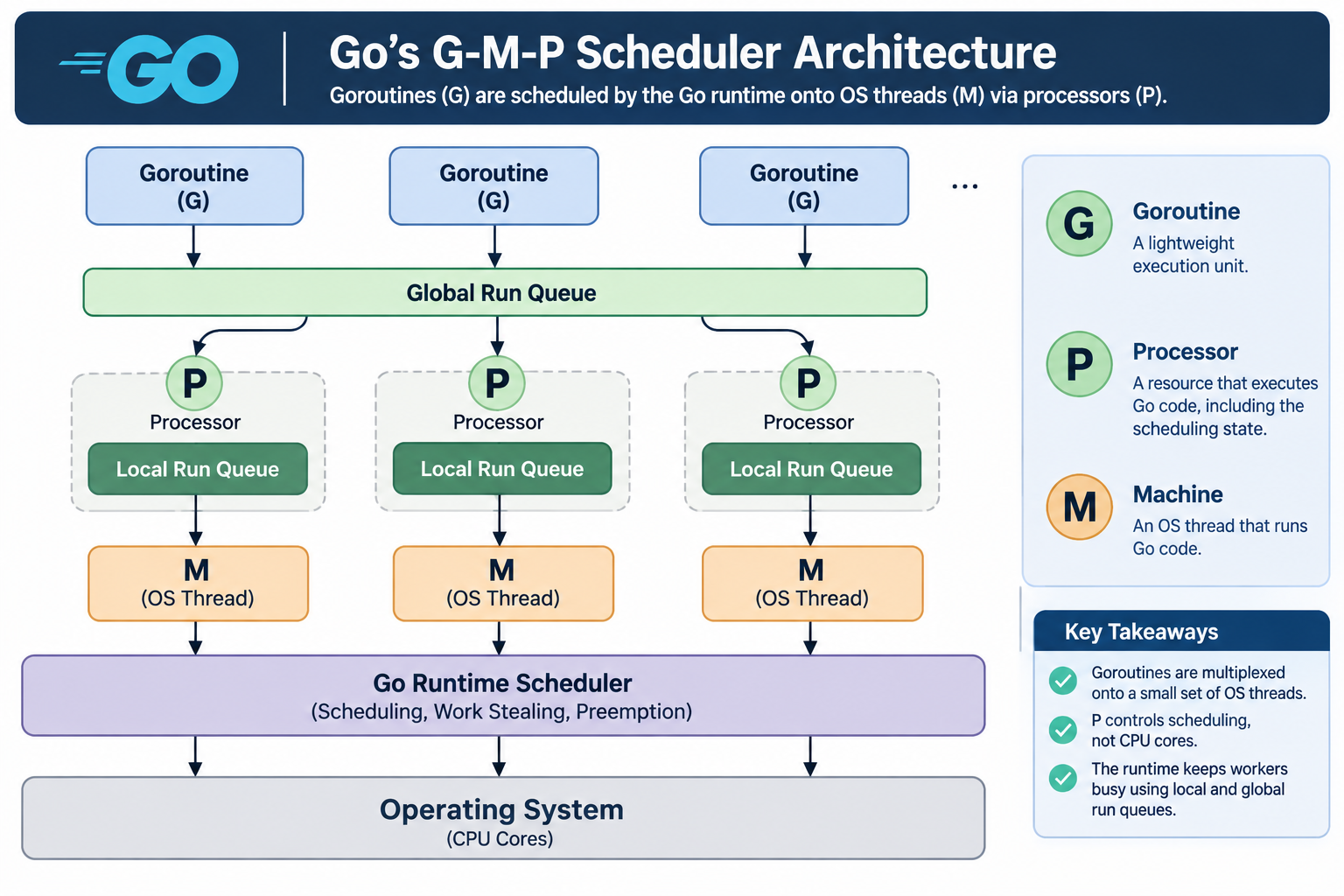
Each P maintains a local queue of runnable goroutines. The runtime schedules these goroutines onto available Ms.
The number of Ps is controlled by GOMAXPROCS, which determines the maximum number of operating system threads that can execute Go code simultaneously.
Consider:
func main() {
    go processPayment()
    go publishEvent()

    select {}
}
The go keyword creates new goroutines, but it doesn’t create dedicated operating system threads.
The runtime determines when they execute.
This has an important implication: application correctness must never depend on goroutine execution order.
Scheduling is nondeterministic, and assumptions about execution order can introduce subtle concurrency bugs.
3. Channels vs. Shared Memory
Go encourages communicating between goroutines through channels rather than coordinating shared mutable memory wherever practical.
This philosophy is summarized by:
“Do not communicate by sharing memory; instead, share memory by communicating.”
Channels provide a typed communication mechanism:
func main() {
    jobs := make(chan int)

    go func() {
        jobs <- 42
    }()

    result := <-jobs
    fmt.Println(result)
}
An unbuffered channel synchronizes the sender and receiver. Buffered channels introduce a finite queue that allows producers and consumers to operate somewhat independently.
Channels are particularly useful for:
- Producer-consumer pipelines.
- Work distribution.
- Event notification.
- Ownership transfer.
However, channels aren’t always the best solution.
Consider a shared counter:
type Counter struct {
    mu    sync.Mutex
    value int
}

func (c *Counter) Increment() {
    c.mu.Lock()
    defer c.mu.Unlock()

    c.value++
}
A mutex is a straightforward solution when multiple goroutines need controlled access to shared state.
The engineering decision should depend on the problem being solved.
Use channels when communication is central to the design. Use synchronization primitives when protecting shared mutable state.
4. Synchronization and the Go Memory Model
One of the most important aspects of concurrent programming is understanding memory visibility.
A data race occurs when multiple goroutines access the same memory location concurrently, at least one access is a write, and there is no appropriate synchronization.
Consider:
var counter int

func increment() {
    counter++
}
Concurrent calls to increment() introduce a data race because the increment operation is not atomic.
Go provides synchronization primitives such as:
sync.Mutexfor exclusive access.sync.RWMutexfor coordinated read/write access.sync/atomicfor atomic operations.- Channels for communication and synchronization.
The Go memory model defines happens-before relationships that establish the ordering and visibility of memory operations between goroutines.
For example, unlocking a mutex synchronizes before a subsequent successful lock operation on that mutex.
This is important because synchronization is not simply about preventing simultaneous writes. It also ensures that changes made by one goroutine become visible to another according to defined synchronization guarantees.
For detecting data races, Go provides a built-in race detector:
go test -race ./...
This should be part of the testing strategy for applications that rely heavily on concurrency.
5. Designing Concurrent Systems for Production
Understanding goroutines and synchronization is only part of the problem. Production systems also need explicit resource and lifecycle management.
Consider a service processing 10,000 jobs.
Creating one goroutine per job might appear convenient:
for _, job := range jobs {
    go process(job)
}
But unrestricted concurrency can overwhelm databases, external APIs, and other dependencies.
A worker pool provides a more controlled approach. A fixed number of workers consume jobs from a bounded channel.
jobs := make(chan Job, 100)

for i := 0; i < 10; i++ {
    go func() {
        for job := range jobs {
            process(job)
        }
    }()
}
This limits concurrent execution to ten workers and buffers up to 100 pending jobs.
In a production implementation, we would additionally need:
- Explicit worker lifecycle management.
- Error propagation.
- Context-based cancellation.
- A defined channel-closing strategy.
- Appropriate handling of retries and failed jobs.
Go’s context package and golang.org/x/sync/errgroup provide useful building blocks for coordinating these operations.
An important distinction is that in-process concurrency control does not provide distributed consistency. A mutex can protect shared memory inside one process, but it cannot coordinate state across multiple application instances.
That requires mechanisms such as database transactions, idempotency, or distributed coordination.
Conclusion
Go makes concurrent programming approachable, but building reliable concurrent systems requires more than knowing how to launch goroutines or communicate through channels.
The real engineering challenges involve synchronization, memory visibility, resource management, cancellation, and understanding the limitations of the underlying execution model.
For backend engineers building high-throughput services and distributed applications, these considerations directly influence system reliability and performance.
Good concurrency design isn’t about maximizing the number of goroutines. It’s about executing independent work efficiently while preserving correctness and controlling resource consumption.
Further Reading
Next: Understanding the Go Scheduler — G, M, P, Work Stealing, and Runtime Scheduling.
Comments