
Two Phase Commit Protocol
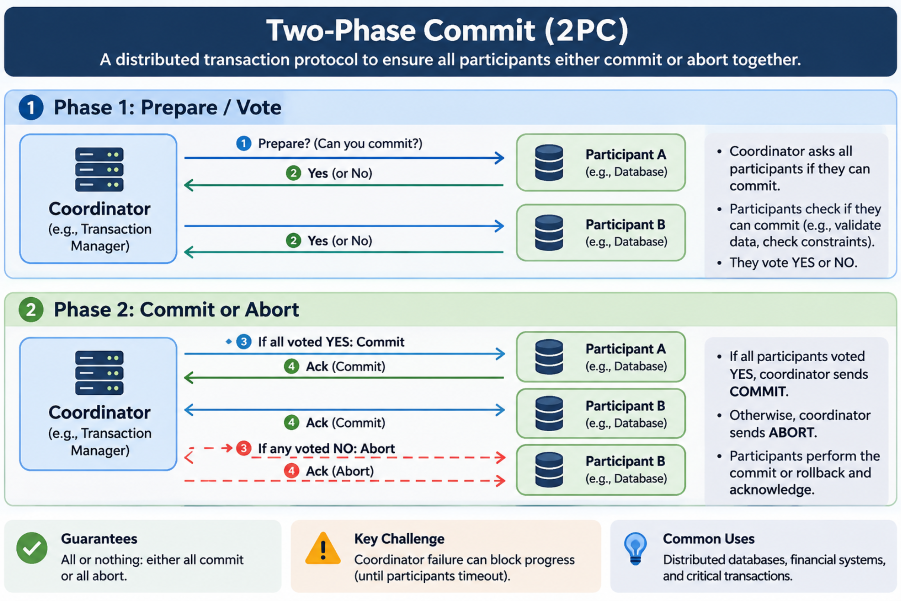
Two Phase Commit (2PC) is a distributed atomic commitment protocol used to coordinate transactions across multiple nodes. It ensures that all participants in a distributed transaction either commit or abort together — maintaining atomicity even when failures occur.
The Problem
Consider a bank transfer that moves money from Account A on Node 1 to Account B on Node 2. Both nodes must agree on the outcome:
- Node 1 debits Account A — succeeds locally
- Node 2 credits Account B — fails locally
Without coordination, you have money disappearing from Account A without appearing in Account B. 2PC prevents this by ensuring both nodes reach a unanimous decision.
How Two Phase Commit Works
The protocol involves two roles:
| Role | Responsibility |
|---|---|
| Coordinator | Drives the protocol, collects votes, makes the final decision |
| Participant (Cohort) | Executes transaction work locally, votes on the outcome |
Phase 1: Prepare (Voting)
- Coordinator sends a
PREPAREmessage to all participants - Each participant executes the transaction up to the commit point, acquires locks, but does not commit
- Each participant replies
YES(prepared to commit) orNO(cannot commit)
Phase 2: Commit/Abort
If all participants voted YES:
- Coordinator sends
COMMITto all participants - Participants release locks and permanently commit
If any participant voted NO (or timed out):
- Coordinator sends
ABORTto all participants - Participants release locks and roll back
Go Implementation
Here is a minimal 2PC implementation in Go demonstrating the coordinator and participant pattern.
Participant
package main

import (
	"context"
	"encoding/json"
	"fmt"
	"log"
	"net/http"
	"sync"
	"time"
)

type Vote string

const (
	VoteYes Vote = "YES"
	VoteNo  Vote = "NO"
)

type TransactionState int

const (
	StateInit TransactionState = iota
	StatePrepared
	StateCommitted
	StateAborted
)

type Participant struct {
	nodeID   string
	mu       sync.Mutex
	state    TransactionState
	prepared bool
}

func NewParticipant(nodeID string) *Participant {
	return &Participant{
		nodeID: nodeID,
		state:  StateInit,
	}
}

func (p *Participant) Prepare() Vote {
	p.mu.Lock()
	defer p.mu.Unlock()

	if p.state != StateInit {
		log.Printf("[%s] Already in state %v, rejecting prepare", p.nodeID, p.state)
		return VoteNo
	}

	// Simulate transactional work: acquire locks, write to undo/redo log
	log.Printf("[%s] Executing transaction work and acquiring locks", p.nodeID)
	time.Sleep(100 * time.Millisecond)

	p.state = StatePrepared
	p.prepared = true
	log.Printf("[%s] Prepared to commit", p.nodeID)
	return VoteYes
}

func (p *Participant) Commit() {
	p.mu.Lock()
	defer p.mu.Unlock()

	if p.state == StatePrepared {
		p.state = StateCommitted
		log.Printf("[%s] Committed transaction", p.nodeID)
	}
}

func (p *Participant) Abort() {
	p.mu.Lock()
	defer p.mu.Unlock()

	if p.state == StatePrepared {
		p.state = StateAborted
		log.Printf("[%s] Aborted transaction", p.nodeID)
	}
}

func (p *Participant) State() TransactionState {
	p.mu.Lock()
	defer p.mu.Unlock()
	return p.state
}
Coordinator
type Coordinator struct {
	participants []*Participant
	timeout      time.Duration
}

func NewCoordinator(participants []*Participant, timeout time.Duration) *Coordinator {
	return &Coordinator{
		participants: participants,
		timeout:      timeout,
	}
}

func (c *Coordinator) Run(ctx context.Context) bool {
	votes := make(chan Vote, len(c.participants))

	// Phase 1: Prepare — send PREPARE to all participants
	for _, p := range c.participants {
		go func(participant *Participant) {
			votes <- participant.Prepare()
		}(p)
	}

	allYes := true
	for i := 0; i < len(c.participants); i++ {
		select {
		case vote := <-votes:
			if vote == VoteNo {
				allYes = false
			}
		case <-time.After(c.timeout):
			log.Println("Prepare phase timed out")
			allYes = false
		case <-ctx.Done():
			return false
		}
	}

	// Phase 2: Commit or Abort
	if allYes {
		log.Println("All participants voted YES — issuing COMMIT")
		for _, p := range c.participants {
			p.Commit()
		}
		return true
	}

	log.Println("Some participants voted NO — issuing ABORT")
	for _, p := range c.participants {
		p.Abort()
	}
	return false
}
Putting It Together
func main() {
	ctx, cancel := context.WithTimeout(context.Background(), 5*time.Second)
	defer cancel()

	p1 := NewParticipant("node-1")
	p2 := NewParticipant("node-2")

	coord := NewCoordinator([]*Participant{p1, p2}, 2*time.Second)
	success := coord.Run(ctx)

	fmt.Printf("Transaction %s\n", map[bool]string{true: "COMMITTED", false: "ABORTED"}[success])
	fmt.Printf("Node 1 state: %v\n", p1.State())
	fmt.Printf("Node 2 state: %v\n", p2.State())
}
Sample output:
[node-1] Executing transaction work and acquiring locks
[node-2] Executing transaction work and acquiring locks
[node-1] Prepared to commit
[node-2] Prepared to commit
All participants voted YES — issuing COMMIT
[node-1] Committed transaction
[node-2] Committed transaction
Transaction COMMITTED
Node 1 state: 2
Node 2 state: 2
Failure Modes
2PC is not failure-proof. Key failure scenarios:
| Failure | Impact |
|---|---|
| Coordinator crashes after Phase 1 | Participants remain locked in StatePrepared indefinitely (blocking) |
| Participant crashes after voting YES | Coordinator waits for its COMMIT/ABORT acknowledgment, may block |
| Network partition | Coordinator cannot reach participants; transactions hang until timeout |
This blocking behavior is why 2PC is often avoided in favor of Paxos, Raft, or Saga patterns for high-availability systems.
When to Use 2PC
Use 2PC when:
- You need strong atomicity across multiple services/databases
- Transactions are short-lived (locks held briefly)
- A coordinator crash is rare enough that blocking is acceptable
Avoid 2PC when:
- You need high availability (coordinator is a single point of failure)
- Transactions span long durations (lock contention)
- You operate at internet scale (consider Saga, event sourcing, or eventual consistency)
Summary
2PC trades availability for consistency. It guarantees that distributed transactions commit or abort atomically, but the coordinator can become a blocking single point of failure. For most modern distributed systems, this tradeoff makes 2PC suitable only for tightly-coupled, short-lived transactions within a single administrative domain.
Comments